Real Repairs: Fixing a Broken Truss Rod
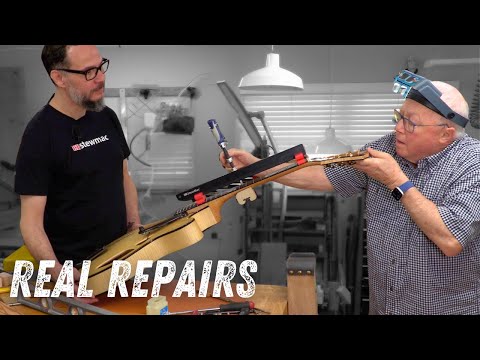
In this episode of Real Repairs, legendary guitar repairman Dan Erlewine tackles a tricky fix—a broken truss rod with stripped threads that can no longer hold an adjustment nut. Watch as Dan walks us through his step-by-step approach, sharing hard-earned techniques and demonstrating some clever specialty tools made just for this kind of job.
Video Transcription
[Fast electric guitar music]
[on-screen text reads: Real Repairs with Gene Imbody]
Gene Imbody: Welcome back to Real Repairs, folks. Extra special episode today. As you can see, we're not in the video studio. We're in Dan Erlewine's shop. When I talked to him about the concept of Real Repairs, he was excited to take part and said he had a perfect example for an episode. So we're in his shop today. So Dan, take it away.
Dan Erlewine: Well, thanks Gene. I don't have a ton to say other than that. I've had this seven string Holst guitar made by Steve Holst from Oregon in the shop for a couple of weeks. The trouble that it has is the truss rod doesn't work. The threatening on the end of the rod is stripped so badly that I guess that they used the wrong tool and grabbed it with vice grips, and all it did was mangle it. So I hope to use the StewMac Truss Rod Rescue Tools to repair it. We fix truss rods all the time. I fixed three last week, three Fenders. This one is not normal to see it that mangled,
Gene Imbody: That one's pretty bad. You've talked to the builder, right so you know?
Dan Erlewine: Yeah, I got in touch with the builder and he was nice enough to send photos of how he installs the rods. And those will be helpful if the rescue tools don't fix the issue, because then we'd have to do some major surgery, but at least we'd have an idea of where the anchor is. I always try to get as much info as I can before I start a repair.
Truss Rod Repair Tools
Gene Imbody: So this brings us into the truss rod rescue tools, which you developed along with Frank Ford. Right?
Dan Erlewine: Frank and I used to go to the Asia and Guild conventions, meet each other and hang out a lot during the convention and talk about repair. One time I told him the story about how I met a man that had worked at Fender and I told him that I wish there was a dye that could go into the end of a fender neck and chase those threads and clean 'em up or even cut new threads. And he said that he thinks they had one at Fender. He remembered seeing it, but it never came to fruition. I never saw and I never saw him again.
And I told Frank about it, and one month this came in. Frank sent this to me and it's the very first truss rod repair die. It should probably be in a museum somewhere. The idea is that this guy would cut through the manl truss rod threads, clean them up so they could still hold a nut again, and that's where StewMac came up with the truss rod rescue kit.
So basically the truss rod kit is two tools with a few accessories. It's a three eighth inch cutter that exposes unused thread or unused rod by removing a small amount of wood from around the damaged rod. Once you're bored away enough wood, you can come in with the thread cutting dye that fits right into the pocket you just created with the cutter and chases mangled threads or cuts new threads. Both of these, by the way, are powered by a T-handle wrench, but I have been known to cut the "T" part of the handle off, so I have a shaft I can put in a drill.
The kit also has washers or spacers as we call 'em, of different sizes that make up some of the differences that you cut away and it gives you control of how deep the adjusting nut sits on the rod and it gives you a steel surface for the new nut to tighten against. And also we make truss rod nuts that are elongated longer than usual in case you have to bore really deep to get onto new threads.
Gene Imbody: These were game changing tools right before this. Oh yeah, you took the fretboard off or you excavated a window like you were talking about. So these really made a repair possible where before it was a pretty major surgery.
Dan Erlewine: Like I said, I did three Fenders last week. Do you want to just get right into this?
The Fix
Gene Imbody: Yeah, let's see what we're working with here. Got to get the uniform on.
Dan Erlewine: Yeah, got to catch that. The most important tool. Alright, let's get in here and cut some wood. You'll notice a little blue tape as I'm cutting. And that's masking tape wrapped around the rod to keep glue off it when it's installed. It's called a sleeve. Some are made out of rubber, some are wrapped in tape. I'm going to start out with a good control on it and slight pressure and see how this wood's cutting. I like to get started slow and see how it's feeling. I'm using firm but not hard pressure.
I can feel the wood. I'm not going in too fast. I can feel it cutting. And here's a little trade secret, use a magnet to pull that cutter out. Did you get anywhere? Yeah, it's starting. There you go. Now we're getting somewhere. I'd say we're in there about three eighths of an inch. Maybe a little more.
Gene Imbody: It's looking pretty good, man. Are you ready to move on to step two?
Dan Erlewine: I'm going to see if I can get on that butchered thread to begin with. So once again, I'm using a 10/32 cutting dye because it's a 10/32 rod, and when you cut, you want to cut a bit and then release the chip. Cut and release the chip.
Gene Imbody: You have some lubrication or anything you need?
Dan Erlewine: I've got some, but I don't know if I want to use it. The less you use any lube, the better chance you have for any kind of wood plug you want to glue in or whatever's happening. So far it feels good. You want to try a little? Yeah, sure.
Gene Imbody: Oh wow. That's cutting real nice. I wasn't really expecting that because of all this mangled damage around here.
Dan Erlewine: Stick it out and look at it.
Gene Imbody: They look better. You can already see on the end they clean the end up pretty nicely. Let's go a little deeper here. Go for it. But at some point
Dan Erlewine: This is not going to want to keep going.
Gene Imbody: We just want to join the mangled part to the fresh thread so you can get a-
Dan Erlewine: No, I'm on all fresh thread now and it's a question of when will it stop right about there. These are clean now it's gone right past the hole where a drill had been used and it's gotten onto the other threads and chased them nice and clean. And this is what we hoped, right?
Gene Imbody: We've got a brand new extension out there. You want to try?
Dan Erlewine: Yeah. This isn't the nut we're going to use, I'm guessing it's way too long. I'm just excited to see how far it goes and how the threads are working.
Gene Imbody: Alright, well this is going to tell us how successful we are so far.
Dan Erlewine: So we're on it right now, so now we'd want to put a washer in there. So this nut bears against the steel washer and doesn't crush the wood. We're going to try to put a nut on it now that's short just to see how far it goes. I think if we put this on, we'll know how far it can go. It's going to bottom out. It doesn't have a clearance hole. Then we measure and we'll know how many spacers to put inside.
Gene Imbody: And it's bottomed out now, but we're not flush or below the surface of the peghead. So a truss rod cover is not going to sit flat. So you're thinking if we go deeper and then what? Use a truss rod nut with a hole through it so we can get further into the nut?
Dan Erlewine: Either that or drill a hole through it. We're just thinking here.
Gene Imbody: What about the possibility of taking a little off the end of that rod somehow?
Dan Erlewine: I wouldn't be afraid to do that.
Gene Imbody: If we removed an eighth an inch off of that rod, that would allow us to go in deeper or what? We could come in with the bigger cutter so that we could use an acorn nut?
Dan Erlewine: Now that's a good idea. When you're talking about a bigger cutter, this is the one. It makes a hole so that you can put a Gibson truss rod nut on it.
Gene Imbody: It would be nice to use the Fender style because of the extra length. A little more strength to the nut. A lot more thread. But the problem is it's not going to allow us to put a truss rod cover. It's sitting above the surface of the peghead, right?
Dan Erlewine: Yep.
Gene Imbody: What do you think if we tried a Gibson style?
Dan Erlewine: I think it'll work perfectly.
Gene Imbody: You want to try that?
Dan Erlewine: Let's put it on and see what it feels like.
Gene Imbody: Alright.
Dan Erlewine: I have a good feeling about this.
Gene Imbody: Yeah, so far so good man, this is going great.
Dan Erlewine: I mean this nut will go all the way down because it's smaller than the hole.
Gene Imbody: So that's touching bottom.
Dan Erlewine: Not yet.
Gene Imbody: No. There you go. So we have some sticking out as is without even a spacer in. I think this is gonna work.
Dan Erlewine: So I think we put a little metal spacer.
Gene Imbody: So with a spacer in there, we'll get even that much more sticking out. And then I don't think we really need to bore more wood out of here. No, I think we're there. This is a weak area in the neck anyway. We don't want to take any more wood out of here than we have to.
Dan Erlewine: And I think that's the one.
Gene Imbody: That's the one? Okay. What do you think?
Dan Erlewine: At one point, I almost wonder if we're pulling the rod out.
Gene Imbody: As you tighten it, it's maybe coming loose from the anchor and creeping this direction.
Dan Erlewine: I'm just saying it's harder than it should. And if I hammer it on this and it goes backwards, that means that on the other end there's a lug. That's the anchor. It's pressing the wood. Maybe only a 16th of an inch, but this will be interesting. No, it's good. Okay, let's shake that. Shake it baby! Thank you. I see it.
[Guitar tech Blake Burkholder enters the shop.]
Dan Erlewine: Hey, hey. What's up man? Come in.
Gene Imbody: Come on in, man.
Dan Erlewine: Remember this Holtz jazz guitar?
Blake Burkholder: Oh yeah.
Dan Erlewine: We're finally fixing the truss rod on camera.
Blake Burkholder: Okay. Did you use the truss rod saver?
Dan Erlewine: All of that? Yeah. And remember how mangled that was?
Blake Burkholder: Oh yeah.
Dan Erlewine: And we can thread right on that now, and we're going to put this washer in.
Gene Imbody: Hey, look at that. We're getting there.
Dan Erlewine: See now-
Gene Imbody: Biting down?
Dan Erlewine: It's starting to hit here.
Gene Imbody: You're bottoming out.
Dan Erlewine: So I would put another washer in.
Gene Imbody: There we go.
Dan Erlewine: If it keeps being the same length, something weird is happening,
Gene Imbody: Then we have a problem to figure out.
Dan Erlewine: Now I got plenty.
Gene Imbody: That looks good.
Dan Erlewine: I believe we found the right combination. That's it, buddy. Okay. Yeah, I can put a lot of tension on this now.
Gene Imbody: And you're not bottoming out on the rod back here.
Dan Erlewine: No, I think I'm good. We can measure to really know.
Gene Imbody: So we've got enough sticking out here now because of those two spacers, and not so much excess thread beyond that that we're bottoming out inside the wrench. So what, do you think we should just try and adjust it now?
Dan Erlewine: I think we should.
Adjusting the Neck
Dan Erlewine: Okay. For years I've been a proponent of loosening the truss rod nut and clamping the neck into a back bow and then using a prop to bend it back and then tightening the rod. It's called helping the rod adjust. So many people don't do it, and I just don't understand that. I'd use my dad's level. I'd block it up at each end and I'd squeeze that neck back till it looks like this and then tighten it. Then I got a little fancier without the level. I made a board with a slot in it and it had a couple little props in each end and did it with that. Now thanks to 3D printing in the Stewart MacDonald understring sanding beam- Dave Flis printed these out- he designed them and had a buddy print 'em out. This is a bar that slides underneath strings with sandpaper on it so you can level frets with strings on. My biggest use for it now is this.
Gene Imbody: I would say though, to preserve a fret leveler just for leveling and take a separate old one to use for this. I wouldn't want to use this to level frets after I've done this too much.
Dan Erlewine: Now it's in a slight backbow. It's not like clamping a Fender neck or a thin (Gibson)- This is a big heavy neck. It's a seven string guitar. You want to look down that? You'll see what I'm looking at.
Gene Imbody: Oh yeah. You're in a backbow now. So I think what this is accomplishing is- as this neck bows back, this rod kind of makes its way out this direction so that the nut doesn't have to do all of that work itself. We're taking all the tension off of the nut. We're not making the rod do the work. We're helping the rod along.
Dan Erlewine: Now, the fear that I might have is that this would break because it's been mistreated.
Gene Imbody: How does it feel?
Dan Erlewine: It feels pretty good. I'd almost want to measure at this point and see if that's touching the end of this or not, and that's worth doing. There's all this gap. It's not even close.
Gene Imbody: There's clearance to the back of that. There you go. It fits.
Dan Erlewine: See that rock?
Gene Imbody: Yeah, you're in a back bow. That's a good sign.
Dan Erlewine: It's working.
Gene Imbody: So the fact that we can get this into a back bow is really showing us that this truss rod's working. Great. I think we should put some string tension on here now and see where it ends up.
Dan Erlewine: Let's string it up and see how we did.
Did It Work?
Gene Imbody: Looking for some strings here?
Dan Erlewine: Nope.
Gene Imbody: Okay, so what do we got here?
Blake Burkholder: I found some eight string sets and then I have one seven string set. That's nickel plated round wound. That's 10 to 60.
Dan Erlewine: Yeah, this should work. If the gauge isn't the same as what he uses or close to it, we're not putting the exact pressure on the neck that he's used to. When you take your guitar to get repaired and set up, you should bring two sets of strings.
The first set, you take 'em on, take 'em off, take 'em on, and they get all worn out. When you finally get what you want, then you put the final set on. I'm going to give Gene the honors here. This guitar is, it's a very expensive guitar. It's a beautiful arch top and there's a lot of really nice handmade parts on it. Like the tail piece made of Ebony.
Gene Imbody: Look at that. Oh my god. You just have to press the button.
Let's see who can play a seven string jazz guitar. Blake?
Dan Erlewine: I bet Blake can. He can play anything.
Blake Burkholder: I'll give it a shot, but I'm no jazz man.
Gene Imbody: Wow!
Dan Erlewine: I'm telling you.
Gene Imbody: Let's see.
Dan Erlewine: It's fixed!
Gene Imbody: Well, Dan, I'm not going to lie. I didn't, I had my doubts that it was going to work, but that's straight.
Dan Erlewine: First time.
Gene Imbody: First time. The Master at work. Way to go, man.
Dan Erlewine: Wow. It wasn't easy, but it was fun. I feel like we just begun, but it's already fixed working so well, that's all I want. It's the Trus rod blues. Tighten it once, tighten it twice. Let me give you a little trus rod advice. Clamp it in a back bow before you start.
Gene Imbody: That's a success folks. Another awesome Real Repairs. My favorite one so far because of Dan. Thank you, sir, so much for everything!
Dan Erlewine: Oh, Gene, the things you say.
Gene Imbody: Oh, a little improv. Thank you, Susan. Thank you, Blake. Hey, good job guys. And thank you folks for joining us for Real Repairs. We'll see you at the bench next time.
Dan Erlewine: Won't be long!


