How to Fully Restore a Broken Headstock - Pt. 1
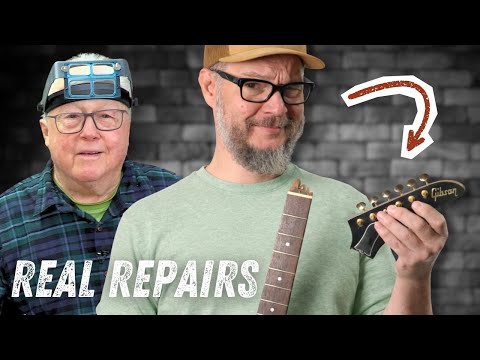
In this episode of Real Repairs, Gene takes on one of the most intense fixes we’ve ever attempted: a Gibson Explorer with a decapitated headstock. But this isn’t your standard repair. With guidance from legendary luthier Dan Erlewine and other shop pros, this job quickly turns into a high-stakes experiment full of risky moves, creative problem-solving and almost burning the shop down!
Video Transcription
[Fast electric guitar music]
[on-screen text reads: Real Repairs with Gene Imbody]
Gene Imbody: Welcome back to Real Repairs, folks. Today we have what is probably going to be the realest Real Repairs we've done so far. What's in this box is a mystery, at least to me. Our good friends at Reverb got ahold of us with a challenge. Whatever's in this box is in dire need of repair. From what I know, this was sent through their Safe Ship program. So if you sell a guitar on Reverb or you buy a guitar on Reverb, if the guitar is destroyed in the process or something bad happens, both the seller and the buyer are covered 100%. So that is what has happened with whatever's inside of this box, and Reverb has decided to take this guitar and they want to use it in their studio at Reverb headquarters. So they contacted us to see if we would want to take this on for Real Repairs.
I'm up for the challenge. Let's dive into it. I'm pretty sure this is an electric. It's kind of heavy.
Who's our Patient?
It's an electric. Oh my God. It's an Explorer with a broken headstock. A severely broken headset. Oh, wow. Okay. I bet the headstock is in here. Yes. We have a bridge. I don't see a tailpiece. Let's get something under the neck for some support. Our patient is an 80s, I'm assuming 80s Explorer. I love these things. Most of the time, traditionally, you see them in Korina. This one appears to be Mahogany. I've actually, I've built an Explorer. I built an Explorer for Scott Hedrick from the band Skeleton Witch maybe 15 years or so ago. Man, I built that one out of Mahogany. So I love these guitars. They're really cool. This has obviously been through the ringer. It's been well played. I'm right away noticing a couple of plugs here, which probably indicates somebody had some mini switches, maybe some coil cuts or something. But let's look at the major issue at hand, which is our headstock break.
Actually, this isn't so much of a headstock break as it is a decapitation. This is about as bad as one gets. If you remember from our very first episode of Real Repairs, I did an SG brake that was at the neck joint and it was pretty bad. It was all completely apart. But the good thing about it is we had a lot of overlapping wood that gives us glue surface. This not so much. It's a very blunt break. It's just been chainsawed off the end of the neck. So these are a lot tougher to repair. I don't have a lot of gluing surface. I want to be careful here. I don't want to knock a bunch of splinters loose, but you can see how this came off. And I'm seeing now there's some chunks of wood gone. And a very curious thing is this dowel.
I don't know what this is, to be honest with you, or how it even got in there. It's obviously had some other work done to it. I can see some finish work. It's been oversprayed, I believe. There's some gapiness right here along this seam. It's kind of a cliche that Gibson Headstocks break. My favorite Les Paul that I own has had a peghead break. And that's normally where you see them are on Les Pauls and SGs with the traditional three left, three right peghead. You'll see them on Explorers very often. If this were a clean break with lots of wood surface, we could glue it on right now and then we could be playing this thing tomorrow. That's not going to be the case with this one. This is a lot more challenging. And the other challenging part about this being an Explorer and the hockey stick aheadstock is that it's a little more difficult to align.
Three left, three right straight peghead is a little bit easier to keep on center with the neck. We're going off to one side here. I don't want to glue this thing on askew, it needs to all line up and look natural. And that's a lot more challenging with a headstock like this. So our number one task is structural, but the second half of that is what do we want it to look like when we're done? They're separate challenges. The really difficult part about this is that it's a natural finish and everything is visible. If this was a black guitar, it'd be a different story. If it was a sunburst, it would be a different story. This is the challenge we're presented with is that we can see everything. The next step is I need to talk to Reverb. What do they know about this guitar?
Can we look at the original listing? Do they know what this weird dowel is? Any information I can get from them is going to be helpful, especially just knowing what they expect. They mentioned that they want to use this as a studio guitar. Do they care what it looks like or they just want it structurally repaired? Who knows? Let's not waste any more time. Let's get Reverb on the phone.
Meeting with Reverb
Gene Imbody: Hey, Tibor!
Tibor Tapiansuri: Hey, how's it going, man?
Gene Imbody: So I've got an Explorer here.
Tibor Tapiansuri: Yeah.
Gene Imbody: Very broken Explorer.
Tibor Tapiansuri: Very broken Explorer. Sitting really sad in its case for off, a number of years now.
Gene Imbody: So I've had a chance to kind of go over it and we opened it live on camera. I didn't even know what I was getting ready to look at. So it was a total surprise to me. I originally looked at it. I've got the peghead here.
Tibor Tapiansuri: There it is.
Gene Imbody: I looked inside and you can probably see that little dowel. At first, there's no way. This had to be repaired once, I thought maybe, and broken again and re-repaired. But no, after I look
Tibor Tapiansuri: Into- This is original?
Gene Imbody: It's original.That's the way they did it. This is a Norlin era, Gibson. They're not particularly-
Tibor Tapiansuri: Infamous.
Gene Imbody: Some of the guitars are awesome and some of them not so much. You kind of hit or miss. I think this is a great guitar, but this I think is some work that's kind of indicative of that era. Something's been done to it because there's some super glue touch-up.
So some sort of repair touch-up has been done to it. I think it originally would've maybe had some Schaller tuners on there. But either way, we just want to discuss how you want to go about it and what your options are. First is we make a new neck for it and we match this one as closely as we can.
That gives us a perfect neck, a perfect fret job, and we will make it look as much as we can like it's never happened. Option B, is we roll the dice and we put this headstock back on however we can figure out how to get it on there and scars and all, and we set this thing up as is and get it back to rocking.
Tibor Tapiansuri: I guess the story that I wanted to try to tell with this guitar is kind of two parts. One, obviously what we try to do here at Reverb and also what you do at StewMac is basically the same thing. We want to make sure that we can get instruments out to people and make the world more musical. And should the unthinkable happen, we're going to make sure you're taken care of and you're going to make sure that instrument's playable.
Gene Imbody: Absolutely.
Tibor Tapiansuri: On the other hand, I'm actually even thinking of a couple layers deeper of trying to demystify broken headstocks. And the value of being able to repair something like this is I actually have a 1968 EB2D that has a broken headstock.
Gene Imbody: A 69 deluxe, Goldtop Deluxe. It's my favorite guitar
Tibor Tapiansuri: Broken headstock too? And I've had some people tell me that it's like the Tommy John surgery when you get stronger after surgery. And obviously there's going to be a change in value of the guitar, especially as we talk about Gibsons and their various eras and how much people are willing to pay. But as a player, I've actually found myself searching for Broken headstock. The 68, I'm not precious about it now.
I'm playing it out and I get to play a 68 EB2. I feel like I'm on the side of wanting to actually show the scars of the guitar. I don't want to hide the fact that this has been put together and Frankensteined back together because I think the story is great. And especially trusting your work and the ability to really make it, as you said, this might not be the worst you've seen, but saying that it's equal to the worst you've seen kind of makes it the worst you've seen.
And as much as I would be interested in also watching a video of you trying to recreate the guitar, I think in the interest of this story, I'd be interested to see a story of how you can bring this guitar back to life showing all of its scars proudly.
Gene Imbody: I love it. Let's put this peghead back on, man.
Tibor Tapiansuri: Hell yeah. Are you up for the challenge?
Gene Imbody: I'm up for it, man. I am more than up for it. All right, so great. We're not making a new neck for it. We are going to salvage this as best we can and we're going to run with it.
Tibor Tapiansuri: Hell yeah.
Gene Imbody: All right, man. Well, thanks for chatting with me. I'm looking forward to this and we'll talk soon.
Tibor Tapiansuri: I can't wait to see the video, man. This is so exciting.
Gene Imbody: Thanks, Tibor.
Tibor Tapiansuri: See you, Gene. Thanks, buddy.
Initial Diagnosis
Gene Imbody: All right, so there we have it. The challenge is to salvage this neck as is as best we can, scars and all. And the very first thing we need to do is spend some time dry fitting this back on here. I've been pretty careful not to disrupt any of this wood. I don't want to make it worse, but now we need to just start making it go back together. And our objective is to get this headstock back on here straight and even and as structurally sound as we can, and then we'll decide what to do past that. Let's just see how it goes on here.
Okay. So that's not terrible, but we've got a gap all along our crack right here.
We've obviously got a chunk of wood missing here. I think there's a little chunk of wood missing out of the side here. It's pretty straight. Let's see what the front looks like. You can see there we've got a gap all along that crack. It's not completely closed and a big gap behind our nut here. So something inside of this break is preventing this puzzle piece from slipping back into place. So this could be a sliver of wood, some compressed grain. Maybe this dowel, the more wood I try to remove to get this to come into place, the weaker it's going to be. I think the first thing I need to do is pull the truss rod nut off. Let's take the nut out of here.
This isn't the original nut. It's been replaced at some point, but we're going to set it aside. I don't know if this washer needs to come out of here? I think for now I'm going to leave this alone. If I had to get it out of there, I'm pretty sure I could. I'm at risk of damaging the end of this break, which might make it fit worse. So I'm looking for any loose splinters or any blunted pieces. All of these splinters fit together like fingers. They break apart, and if they're undisturbed and they fit back together, everything locks in. It's stronger. It helps align the joint. But if just a couple of those fingers get blunted or smooshed, then suddenly it doesn't want to go back together. Tibor told me that this damage happened a long time ago, and the longer wood sits apart, the less likely it is to go back together perfectly.
And it might be playing into why we're having this problem to begin with. No matter how much refitting I do, I may not be able to get this to go back together perfectly. But before I take a drastic measure, the one other thing I need to do, and I'm kind of suspicious, is this dowel. So if I come in here and just chisel away at this dowel, chisel away at some of this goopy glue that was originally in there from the insertion of that dowel, maybe that will enlighten me here. It'll expose something I'm not seeing. Maybe it will allow this to slide back together. I don't know. It's worth a shot. It's low stakes. I might as well do it and see what that tells me.
So here's one thing I'm noticing, and this is the kind of stuff I'm going to be looking for is we have a loose fiber of wood right there, that's about ready to fall right out. It could be the cause of that gap all the way around there, just a little piece like this. Let's just drop this out of here. I don't want to cause any of these. That's why I'm trying to be careful when I fit it back together and not mess with it too much. So let's look at the neck end here. I've got some glue right here. This would be from our dowel from when that was inserted. That could be hanging this up.
There's a chunk of glue that doesn't need to be there. I'm going to use a little deglue goo here on this chunk of a little dried glue. That'll help soften it and make it a little easier to remove. This stuff is pretty good at softening old wood glue. We'll give that some time to work there and we'll work on the headstock.
So I'm just going to come in with a chisel and remove some wood off of the surface that would be touching the neck just to make sure it's not causing us a problem.
One thing I'm noticing while I've been in here chiseling away at this dowel is I've got a loose tooth right here, this chunk of wood that's ... I bet I could get in and pull that out of there. That could hang us up for sure. So that was just hanging in there. It's out of there. So it's starting to loosen up here, soften up. I'm just going to pick away at it gently here and try not to disturb too much area around it. Let's see how the fit is here. Oh, wow. That looks good. Let's take a look at what we're dealing with here. This is definitely more flush than it was. I don't feel this lip like I used to. I'm pretty closed all through here. All along here looks pretty good. I'm missing wood here. Let's look on the front side here. Oh, that looks great.
I've just about got this whole gap closed. I'm almost lining up with my truss rod cover hole right here. We already know we're looking good through here. So any repair like this is a choose your own adventure book. Every decision I make is going to lead me down a different path. And ultimately, when we get to the end of the story, I might look back and go, "I wish I had gone left instead of right." But at the end of the day, we need to make a judgment call and we need to proceed with that and see what that opens up. See what that presents, what challenges we have to overcome at that point.
So given that, the fit is good enough, the crack is closed enough, everything lines up and it's straight. I'm going to glue it on as is. We're going to let that dry and we're going to see what it gives us and we're going to decide about how to reinforce it once we have a chance to evaluate all of that work.
The Glue Up
Gene Imbody: I'm here with my colleague, Ceil. She is the newest member of the StewMac Tech Department and a long time apprentice of Dan, like many of us. She's here to help me because a lot of times an extra set of hands for something like this is very helpful. And speaking of Dan, we are also in the Erlewine Neck Jig.
We're not quite using it for its intended purpose today. Dan invented this many years ago for more accurate fretwork to simulate neck tension, but it makes a great tool for just holding the guitar in place. We can tilt it and get a better view of things. I don't have to keep my hands on this guitar. It's just stable. It allows me to concentrate where I need to. And I'm also going to use it to clamp up my headstock today. I've added a few extra parts and modified it a bit, and I'll show you what this is all about here momentarily.
So anytime you do a job like this, you have to spend plenty of time dry clamping and practicing all of this to make sure that it goes as smoothly as possible. So Ceil and I have already done this and what we've rigged up here is a way of using rubber bands. I'm going to use these instead of clamps because I don't need to sandwich this back together. It's not a break where there's a lot of gluing surface that needs to close. All of the pressure needs to go inward into the neck. So I can get those fingers we talked about to feed back into one another. So let's talk about glue.
We have two major options for something like this, epoxy or wood glue. Our objective here is just to get this headstock on here straight. Later, I'm going to come back in and choose a way to reinforce all of this, which is likely going to involve me coming in and milling out all of this damage anyway.
So all of this gluing surface is more than likely going to be removed in the end. So the glue we use right now isn't going to play a major role in the structural integrity of this repair. An epoxy is messier, it's sticky. I could potentially glue my rubber bands to it. To make it easier on ourselves, we'll just use some wood glue.
Wood glue cleans up with water. It gives me plenty of open working time. And worst case scenario, if something goes wrong and I come here tomorrow and this all fell apart and the peghead's crooked or something terrible, I have the opportunity to undo this glue joint if I use wood glue. I don't plan on that happening and that's why we practiced. So it's just an added safety measure and it's just a little easier to work with. So we're going to go with Tightbond III.
Ceil Thompson: Nice. See, normally I use Tightbond I.
Gene Imbody: Yeah. Tightbond I is great stuff too. I use it a lot. And if we had a really clean, just an open crack with a bunch of gluing surface, type bond one is fine. But Tightbond III gives me a little more open working time so I can position this. And if anything goes wrong, we have more time to recover from it. And it is a little stronger.
We've done tests in the R&D shop here many years ago, tried all the different glues to just get a sense of how strong they actually were. And Tightbond III was clearly stronger than any of the other wood glues that we tested. I think it's because it has just the slightest bit of flex to it. It's not like rubber, but like a tree that's blowing in the wind.
If it's got a little bit of give to it, it's less likely to break. So I do like it for structural stuff like this. Okay. It's time. Are you ready, Ceil?
Ceil Thompson: I'm ready.
Gene Imbody: All right. The first thing we need to do is protect the threads of our truss rod. I don't want to goop a bunch of glue in there that I have to worry about cleaning out later. I like to do that with just a piece of heat shrink. So our heat shrink is just going to keep glue out of the threads. Try not to set everything on fire. Just that. I cooked that just a little bit right there. I did almost set that wood on fire. That's fine. Okay. Fire's out. Let's get on with it here. We'll get some glue way more than we actually need. Glue brush. All right. I'm going to coat both surfaces with some wood glue here.
Don't need to be in a super hurry here. It's fine to give this glue just a few minutes or so to tack up. It's part of the beauty of Tightbonds. You don't need to be in a huge hurry. We'll get the neck. I also want to be careful that this brush doesn't shed inside of here.
Tilt this forward a little bit. Look good, Ceil?
Ceil Thompson: Looks good to me.
Gene Imbody: All right.
Ceil Thompson: Plenty of glue.
Gene Imbody: Plenty of glue. Beautiful. So I took the time when we practiced to set this to the right height to make sure that I'm not this way or this way and the crack is closing. So my dowel's going to go through the D string. Clean up some of this glue with a little warm water. And I want to see glue squeezing out everywhere. Kind of the reason we add more than we really need. And that's why we've got the heat shrink. Otherwise, this would be drying in the threads.
That worked really well. All right. So let's make sure we're still straight. That looks beautiful. What do you think, Ceil?
Ceil Thompson: Yeah, getting rid of that.
Gene Imbody: It all looks aligned really well. The crack looks great. I don't have any major lips either way. Let's get our rubber bands on here to pull that crack completely shut. And then hopefully I will see more squeeze out when that happens. Get some good pressure. After I wrap it a few times, it should stay. Oh yeah. We got some good squeeze out already happening through here.
I'm going to wrap on the bottom too. Oh yeah. We've got a bunch of really good squeeze out going on here. Everything's looking great. It's all aligned. I don't have any big voids. This all looks exactly like it looked when we were practicing and we were pushing it together on the bench fitting it earlier. How's it look from the front? Does it all look straight this way?
Ceil Thompson: Yeah, it looks good.
Gene Imbody: So the last thing I want to do is wrap a rubber band this way on it to pull that veneer down and just to give it a little pressure inward. Great. Teamwork.
Ceil Thompson: Sweet.
Gene Imbody: Pressure there. Everything seems sturdy. What do you think?
Ceil Thompson: Now we wait.
Gene Imbody: Yeah, we'll give it a full 24 hours before I put any stress or anything on it. And thanks, Seal, for your help. We'll see you folks tomorrow. Oh, I was super nervous about this last night that I could hardly sleep, but I am very pleased with how this came out. The Headstock is on there very straight and it's way stronger than I expected. I do feel a little better because I'm wearing my lucky hat. It has a little blood on it.
If you want to see how that happened, check this video out. But I'm also noticing some things I didn't pick up on when the Headstock wasn't attached. It had me a little concerned. So the next adventure I choose is a critical one and I want a second opinion and I know just the guy.
Consult with Dan Erlewine
Dan Erlewine: Killer, man, you got the peghead on.
Gene Imbody: Yes.
Dan Erlewine: I saw the post that you and Ceil did of this in the studio with all the rubber bands.
Gene Imbody: Yeah, we used the neck jig, jimmied it all together and it actually went great. It's stronger than I anticipated it.
Dan Erlewine: I'm proud of you, man.
Gene Imbody: Thanks, man.
Dan Erlewine: What's the glue?
Gene Imbody: I used Tightbond III. I was going to use epoxy. It's actually stronger than I was anticipating. But now that I've got it on, I'm noticing a few things. I'm noticing some just natural flex to that peghead, like outside of the break, kind of just the nature of an Explorer and the fact that this thing is-
Dan Erlewine: The hockey stickers.
Gene Imbody: Yeah. And to look, it's cobbled together just from the factory out of three different pieces here. Piece right here, and then they graft it on a piece going across the top. That's what that dowel is for. I imagine there's probably another one in here somewhere. So it's just, I think, inherently kind of a weak design. So that's why I'm here today. Talk about my options for reinforcing this crack.
Dan Erlewine: The most common way would be to put splines in the peghead.
Gene Imbody: Yeah, you see that a lot. I made up a couple here to demonstrate.
Dan Erlewine: Good stiff chunks of wood. Nicely inlaid into there so they don't look too ugly and then put a backstrap over it. You'd remove maybe an eighth of an inch of wood,
Gene Imbody: All the way down-
Dan Erlewine: All the way down into here.
Gene Imbody: Yeah.
Dan Erlewine: That would look good.
Gene Imbody: Yeah. So I'm not a big fan of splines. I mean, I got away from doing splines a long time ago. When I see them, there's sometimes poorly fit. I've seen gaps around.
Dan Erlewine: I haven't been using splines for a long time because I have a milling machine.
Gene Imbody: Yeah.
Dan Erlewine: And it can do things that you can hardly do with the router without spending ages to set up boxes and routing things.
Dan Erlewine: I wouldn't do them if you could see them.
Gene Imbody: Yeah. I think no matter what I do, it's going to be visible. So having said all that, I've been thinking about this a lot and I'm considering three options that I want to run by you.
Dan Erlewine: I want to hear them.
Gene Imbody: All right. The first is the minimal approach. Because this glue up turned out way stronger than I expected, I could possibly just come in and finish this job by injecting epoxy into any voids I can reach and patch in some fresh wood into this gap. Quick and easy, very conservative, and it avoids major surgery. And the bonuses, it won't require any extensive finish work.
My second option is a variation on the traditional reinforcement method. Instead of routing two obvious channels that leave me with the telltale headstock repair stripes I dislike, I mill out larger chunks of wood from each side of the truss rod to remove the bulk of the damage and I graft in fresh mahogany and shape it into the neck. Maybe even a backstrap over that for added strength, it will be totally solid, but we trade the cool battle scars for a patched in puzzle piece look that will require some tricky touch up work to make it look decent.
The last option I'm considering is working from the top down. This is a bit of a wild card. I could go ahead and remove the overlay, part of the fingerboard, then carefully route slots through the neck, into the headstock, and inlay stiff carbon fiber rods. These are very lightweight, stable, and strong. Then I create a clean cavity across the face of the peghead that is inset about an eighth of an inch all the way around the perimeter to inlay a heavy duty carbon fiber sheet. These are insanely stiff and strong, but light is a feather. The crack will be bulletproof and the peghead will no longer flex. Then we replace the overlay and put back the fretboard.
This is what I call the $6 Million Man approach. For those of you old enough to get that reference. It will be stronger than it was even before the accident.
Dan Erlewine: So let's talk about the risks of all three methods and that'll help us decide.
Gene Imbody: Okay.
Dan Erlewine: Okay. And option one, the bare minimum, what if it doesn't hold?
Gene Imbody: Yeah.
Dan Erlewine: Or let's say it holds for a month or six months and then it breaks off, then you're in trouble with Reverb and you look bad.
Gene Imbody: I look bad. Yeah.
Dan Erlewine: After all that, it's really going to be hard to fix.
Gene Imbody: Yeah. A re-repair of this would be a nightmare. I'm ruling out the minimal approach, but if this was my guitar, that's probably what I would do because I know I could handle it. It's my own guitar.
Dan Erlewine: You'd fix it again.
Gene Imbody: I'd just fix it again and I would learn something from it like how much reinforcement is actually necessary, but it's not my guitar. It's Reverb's guitar. And I need to be able to rely on this.
Dan Erlewine: And let's go on to number two. Option two, I like better because it's going to be stronger for one thing than two little splines. You're going to come in with a face cutter and mill out this and put fresh mahogany in and then you'll miss this. That's good. You don't want to get rid of the decal, but you could also blow that big head right off in there, man. It's a little risky. With a whirling, that would scare me and it's not going to help with the flex at all.
Gene Imbody: Yeah, right. Yeah. If I did that, it would be totally solid. I've done it before. It's what I started doing when I got away from splines a long time ago, just removing larger sections of wood using the mill. But like you said, it's dangerous whenever you get something like this in a mill with a giant cutter spinning fast. And Reverb has expressed that they would like to still see these scars that I not go too far to hide this.
Dan Erlewine: More relicing.
Gene Imbody: Yeah. People pay good money for relic work like that now. So I kind of like the idea of still seeing the scarf.
Dan Erlewine: Me too.
Gene Imbody: Touch it up a little bit, but let it be.
Dan Erlewine: Option three, working from the top down. That means the face down, right?
Gene Imbody: Yeah.
Dan Erlewine: Whoa. Let's see this. Now you're talking, if I got this right, you're going to cut off some fingerboard, you're going to peel off the overlay. You're going to get in here with a router or a mill and you're going to route a pocket, but you're going to leave the wood on the outside so it looks like it's never been touched.
Gene Imbody: And this-
Dan Erlewine: And you're going to inlay. This is crosshatched. What do you call this?
Gene Imbody: Carbon fiber.
Dan Erlewine: And it's going two different directions?
Gene Imbody: Yes.
Dan Erlewine: Wow. And then you're going to run ... Okay, you're going to have splines, but they're going to be hidden splines. Damn. I think you're nuts in a way. You might regret this, Gene. Yeah,
Gene Imbody: It could be ... It's risky.
Dan Erlewine: This could be taking this off. You could undo what you already did. Taking this off, you're going to use some heat and that could affect this. I'm for it. Let's do it. You know me.
Gene Imbody: Yeah.
Dan Erlewine: I like the hardest way possible.
Gene Imbody: I learned it from you, man.
Dan Erlewine: Oh, wait a minute. I just thought of something. Oh, this might change everything. I like your idea, but this is a 3D printed fixture that Ian Davlin made last year on the Looth Group that went on the fretboard, clamped it on, and the drill bit went through it. So if you can imagine the drill bits coming through and you drilled right through the fretboard into the peg head and put two carbon fiber rods in there.
Gene Imbody: Oh, so yeah.
Dan Erlewine: Round.
Gene Imbody: Instead of flat bar stock, they make this round too.
Dan Erlewine: I'm thinking of that diameter. Small enough?
Gene Imbody: Yeah. Okay.
Dan Erlewine: And since you'll have taken the peghead overlay off of this, you've gone in there and routed wood out, right?
Gene Imbody: I see where you're going. Yeah.
Dan Erlewine: And that gives you a good angle to come in here real low and drill right down into the neck on both sides.
Gene Imbody: Yes.
Dan Erlewine: Slide in the carbon fiber with epoxy. You're going to put carbon fiber in this, inlay it down in. Getting this off, I think I would just get a dremel tool and just start carving away.
Gene Imbody: Just take it off. Yeah. Don't even worry about heating it.
Dan Erlewine: I don't want to heat it right in there.
Gene Imbody: Okay.
Dan Erlewine: Just what if we did and it just sags?
Gene Imbody: Yeah. It is a little risky. I like this idea, Dan.
Dan Erlewine: Oh boy. This is even better.
Gene Imbody: I knew there was a reason I came to visit you today. The biggest advantage is I don't have to take this piece of fretboard off. I can just do all of this work coming in this direction. I love it.
Dan Erlewine: Anybody who know the wiser.
Gene Imbody: Okay. It's decided.
Dan Erlewine: I'm with you.
Gene Imbody: All right.
Dan Erlewine: God speed. Let me know how it comes out. If you have any troubles, give me a call.
Gene Imbody: I just might do that. Thanks, Dan.
Dan Erlewine: You're welcome.
Gene Imbody: That was pretty awesome. Nobody thinks outside the box like Dan and got my propensity to do complex solutions from him to begin with. So it's pretty fitting that he gave me a better idea than it had. So I'm pretty stoked at this and I've got some things to think about.
Plug Graft and Vaneer Removal
Gene Imbody: Before I can start the reinforcement work, I had to patch the large gap in the back of the neck. So I grabbed my favorite chisels and prepped it for a plug.
Once it was all trued up and clean, I transferred the cavity measurement to a matching piece of mahogany and rough cut it on the band saw. Then I ran that piece through the thickness sander until it matched the cavity width exactly. Using some tape, I transferred the angle at the end of the cavity onto the mahogany fill piece.
I roughed that out on a band saw, then cleaned it up on the belt sander until it matched the end of the cavity perfectly. Next, I cut the piece to length and roughed in the bottom curve on a flat beam with some sandpaper until I had a close match. The plug needs to mate perfectly with the bottom of the cavity so I had some careful fitting to do. Coloring the bottom of both pieces with some white pencil, I floss between them with a strip of cloth back sandpaper, flipping it to hit both sides as I go.
The pencil marks show where I'm hitting and where I'm missing. And once I can remove an even layer of white everywhere, I know I'm good. Once the seams matched all the way around and I was happy with the fit, I mixed up two batches of epoxy, a larger batch of clear, and a smaller one tinted with blend all powders to match the neck finish.
The tinted epoxy will fill any tiny imperfections around the edges. I eyeballed the color and used a piece of clear cellophane to check against the neck without actually applying the glue. I got lucky and nailed it on the first try. I injected clear epoxy into all the voids and spread it across the bottom of the cavity. Then I painted the cavity walls with the colored epoxy so any squeeze out would match the original finish. I inserted the plug and made sure the tinted epoxy squeezed out everywhere and cleaned up the excess with alcohol on a rag. Once everything looked good on both sides, I clamped it tight with a heavy duty rubber band, just like I'm putting a cast on a broken leg.
Once the epoxy fully cured overnight, I removed the rubber bands and the plug was looking great. So I used a flush cut saw and a Teflon guard so I could cut it really close and protect the finish. Then with a variety of chisels, scrapers, and a few different files, I shaped it into the rest of the neck, following the natural contours as closely as I could. We'll refine this later and make it look great in the touch-up process. Next up is removing the veneer. Dan warned of the dangers of trying to heat this off, but I had to try. A pot of hot water keeps my knives warm and clean while a heat gun and an infrared lamp bring everything up to working temperature. I monitored it all closely. Thermometers are critical. Wood glue starts to soften around 150 degrees, so the knives need to be pretty hot.
But if I go too far, I risk compromising my glue joint, damaging my finish, and hanging my head in shame to Dan. Once I was well under the overlay, I brought in a second knife to help me out on the other side of the peg head. My plan was to slowly peel this overlay up from the front to the back.
And it was all going quite well until I hit the area just past the D-string. The glue fought me a little more here and one of my knives started to follow a grain line into the headstock. But once I cleared the G-string, it was smooth sailing to the end of the peg hit. Well, that went about as well as I could expect it. I'm pretty pleased with that. I dug into the wood a little bit here, and this is where I was struggling. I was diving into a splinter right here, but I pulled it out in the end. I lost a little bit of the overlay right here. Little chip pulled right here, but at the end of the day, I couldn't ask for anything better than this. The last step is cleaning up a few small mahogany chips and bits of overlay left behind.
These chips are very thin, so sandpaper on a flat block, along with some razor blades and chisels, makes quick work of the cleanup. I clamp the overlay flat so it won't warp while we proceed with the repair. The next step is to route the face of this headstock, and for that, I need a routing template. I recruited my buddy Todd Sams for this job. Todd is head of R&D at StewMac, and he's super knowledgeable on CNCs and laser cutters. We scanned a photo of the headstock veneer and Todd ran that through his drawing program. We'll use that on the laser cutter to first create a pattern out of thin acrylic and verify our specs against the Explorer headstock. Todd's going to be busy for a while tweaking this program until he can make me a heavy duty template I can use for routing. So I'm going to move on to training for the most nerve-wracking part of this entire fix.
An Unexpected Twist...
Gene Imbody: So I've had a few stressful days, some sleepless nights thinking about this next part, the make or break point of this entire video. Removing the overlay was tricky, a little stressful. Routing the channel for the carbon fiber plate I'm going to put in. That's a little risky too, but nothing scares me as much as drilling two long blind holes underneath this fretboard. About six inches long I need to come from about here to here on both sides. Through a three-dimensional curved changing neck, I have to take this long bit and not be off even a fraction of a degree, or I'm going to bust out the side of the neck. I might bust into the truss rod cavity. Any number of things could go wrong with this step. So what I've done is bought this Explorer kit off of Reverb. This went for about 190 bucks, which I think is a pretty small price to pay, to have the opportunity to practice this next step a couple of times.
And we'll finish this guitar out later and it will start its life out with a bulletproof headstart. So I am nervous, but Dan Erlewine did me a solid. Let me show you something.
He 3D printed a jig for drilling these holes based on the one we looked at in his shop that Ian Davlin designed. And I've learned since then that the original concept for this jig came from James Roadman, who is an excellent machinist and top-notch Luthier whose work I really do admire. So shout out to both Ian and James for this excellent idea. And another fun fact, Ian and I both have dogs named Kevin, but I must admit his Kevin is always a little better dressed than mine. So Dan 3D printed this block at the right angle. You can see the angle on this line on the side and then ran a brass tube through it to guide my drill bit. Now he left it too long because he wasn't exactly sure how long I would need it. And you can see here that it needs to rest on the surface of my peg head and extends beyond that.
So I need to trim this off so it's flush here and then figure out how much length I need in the back so that I'm able to extend this bit to somewhere around my third fret area. So we need to do a little math here and cut this tube off and that's what we're going to do next.
So I have 500, I have 675, 1670.
96 and a half thou to the center of my hole. It's a 16th. Boy, that's small. 36. It is such a small window. 193 divided by two. If all of my math is correct, I should be able to travel through my brass tube towards my third fret all the way to about here, and not bust out the back of my neck. I'm not worried about here at the peak of this curve. I'm worried about here on the cheeks where I'm a little bit thinner and I'm traveling at a little bit of an angle towards the glue line of the fretboard in the neck. If anything, I'd rather hit the bottom of the fretboard. Well, I've done my best to prepare and if I'm going to make a mistake, I'd rather it happen now. And if it's not right, I will have to figure out where my math went wrong or what I didn't account for.
Let's just see what happens here. Fitting through. You got to be careful about how it even starts because ...
Sorry, Susan. I had my phone out to do that math and I didn't put it away. Uh-oh. No. It's Todd. What's up? Hey, we got a problem. Laser cutter caught fire. Oh, what timing? Oh, he's down in the shop. Okay. Cut. Hey, man.
Todd Sams: Hey, Gene.
Gene Imbody: All right. You want to show me what happened over here?
Todd Sams: I think it lost air pressure, which is supposed to blow the heat through.
Gene Imbody: Oh.... Okay.
Todd Sams: Stop it, and it just built up right under there, smouldered.
Gene Imbody: Wow. We're lucky it didn't set the whole sprinkler system off.
Todd Sams: The cut had finished, so everything was good. We walked away for a minute because the thing was done. Shut down, and one of the Waverly workers on that side had noticed something. So they told Brandon. Brandon rushed over, and so I ran over. Brandon already had the extinguisher and he just hit it right as I was coming up.
Gene Imbody: So how long of a span of time?
Todd Sams: It couldn't have been two minutes.
Gene Imbody: Two minutes that went from functional to barbecue grill. Is there a replacement on the way for sure yet? Do you know?
Todd Sams: The larger one to replace this is still being hashed out.
Gene Imbody: Okay.
Todd Sams: We did get quotes.
Gene Imbody: Well, I promised this was going to be the realest real repairs yet, and I definitely did not have laser cutter bursting into flames on my bingo card. This throws a monkey wrench in things. I need to rethink how I'm going to make this template. Maybe we just ditched the laser cutter idea and I go old school with this. I think this just became a two-part video.
For now, I need to turn my attention back to drilling these holes and put my mind back on the task at hand here. It's good. There's the end. Here goes nothing.
[on-screen text reads: To Be Continued]